Tools for closed-loop science

Potato builds the translation layer between biological intent and lab execution. Our software turns protocols, literature, constraints, experimental designs, plate layouts, run data, and next-round decisions into structured systems that scientists, automation teams, and agents can use.

Get started with Potato

Built around the experimental loop

Closed-loop science requires more than an AI assistant and a liquid handler. Each stage has to produce information the next stage can use.

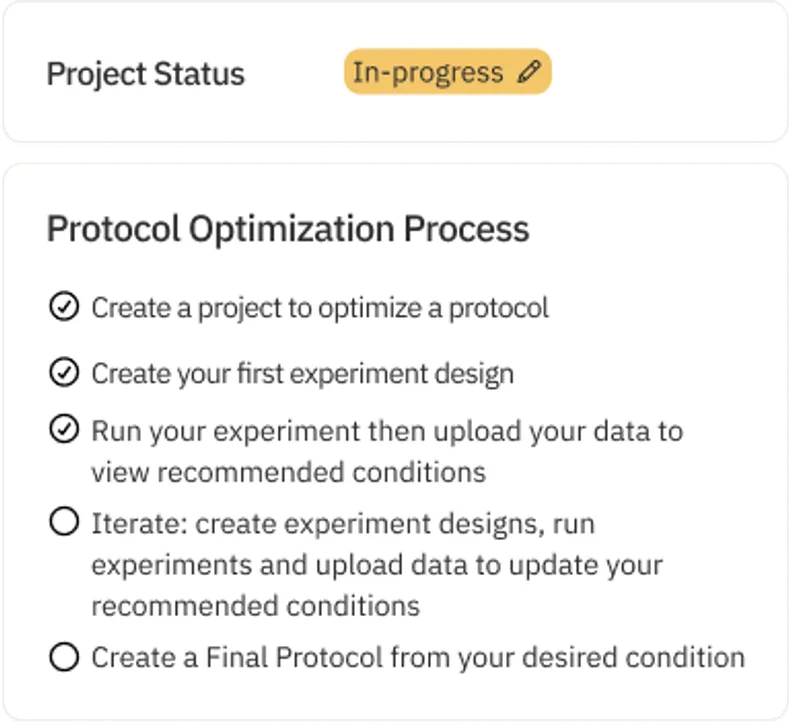
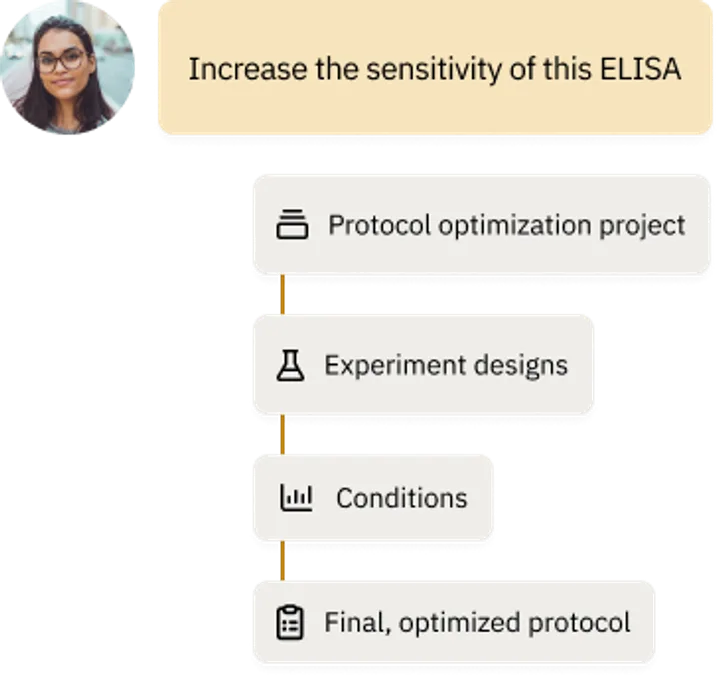
Potato structures that handoff across the full loop: plan, design, execute, and iterate.

Plan

Turn scientific context into structured inputs

Every experiment starts with context: a protocol, a paper, prior data, a biological question, performance targets, and/or constraints.

Potato turns that context into a structured experiment model. Reagents, concentrations, actions, intermediates, controls, readouts, and candidate parameters become information the system can reason over.

From there, Potato can surface what is missing, clarify what is ambiguous, identify what can be varied, and surface supporting literature to guide the experimental design.
Design

Selecting the parameters and variables

Potato helps teams define what should be tested and why.

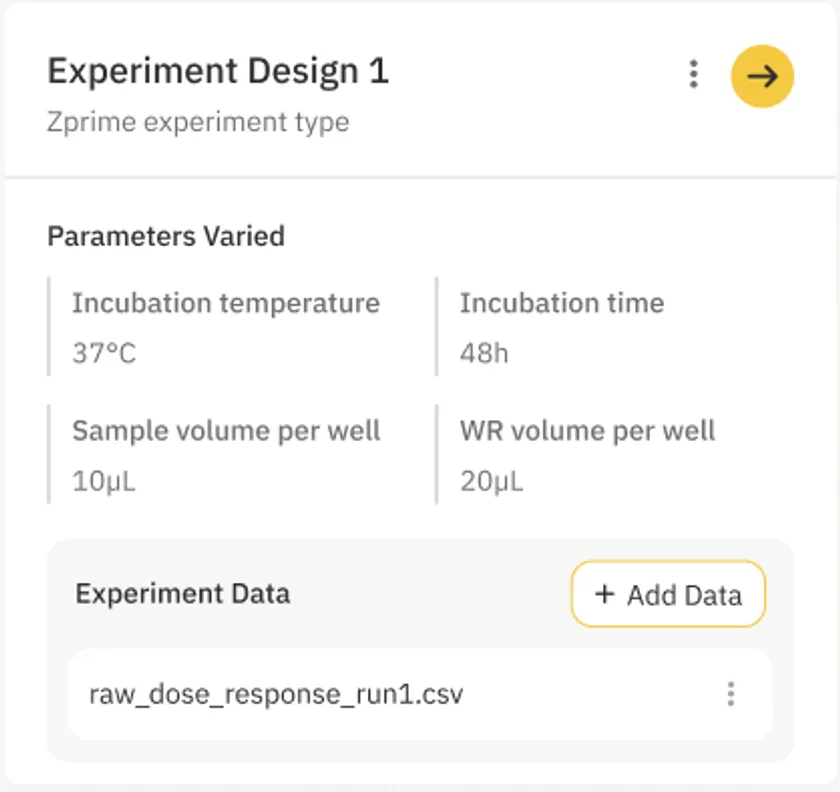
The system identifies candidate parameters, ranges, controls, and physical lab constraints, then helps generate experimental designs that explore more of the space than one-variable-at-a-time troubleshooting.

Depending on the workflow, that can include full factorial designs, Latin hypercube sampling, and Bayesian optimization when prior data is available.

The goal is to learn more from each run before moving to the next one.

Execute

Compile designs into lab-ready instructions

Potato translates experiment designs into concrete execution plans: what liquids move, where they go, in what order, at what volume, and under which timing, incubation, or plate constraints.

Under the hood, Potato uses a compiler-like system for liquid handling. It turns the experiment into a graph of liquid transfers, checks the design against lab rules, and generates outputs such as protocols, condition tables, plate maps, worklists, and robot-adaptable files.

Iterate

Carry the data into the next experiment

After each run, Potato connects results back to the conditions, parameters, controls, and design choices behind every well.

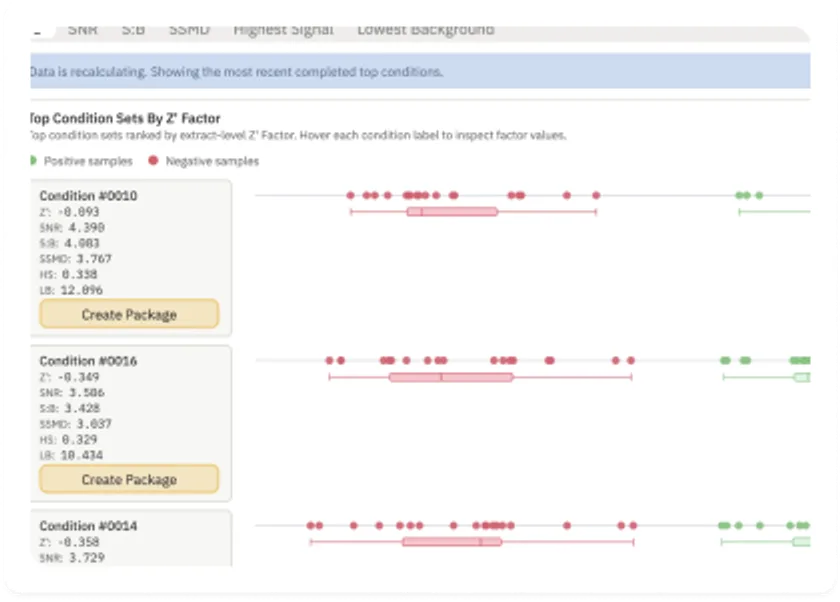
Teams can rank performance against assay-specific metrics such as signal, signal-to-background, signal-to-noise, Z-prime, CV, or SSMD.

That data then informs the next recommendation. Each round carries forward what was tested, what changed, what worked, and what should be tried next.

One technical foundation.
Multiple products.

Potato products are built on a shared technical foundation for closed-loop experimental work.

Scientific context layer

Shared scientific context for protocols, papers, prior data, assay goals, user constraints, and supporting sources.

This layer gives tools a reusable knowledge base around a question, method, or experiment instead of starting each task from a blank prompt.

Experiment modeling layer

Structured representations of experimental work: reagents, concentrations, actions, intermediates, controls, readouts, parameters, physical lab constraints, and goals.

This is the layer that makes protocols and assay logic computable.

Design and optimization layer

DoE and optimization methods for selecting parameter sets, testing multiple variables, and prioritizing conditions under real lab constraints.

This layer supports full factorial designs, Latin hypercube sampling, and Bayesian optimization when prior data is available.

Execution layer

Compiler logic, plate layout intelligence, and constraint checks for turning designs into lab-ready outputs.

This layer supports protocols, condition tables, plate maps, worklists, and robot-adaptable files while accounting for volumes, timing, labware, liquid transfers, and instrument constraints.

Analysis and feedback layer

Result-to-design mapping for experimental data.

This layer keeps data connected to wells, conditions, controls, parameters, and performance metrics so results can inform the next decision.

Setting up these tools would normally be a time-consuming process that prevents us from learning what works for our needs.
Now, we can focus on our own R&D.

— Anand Muthusamy, PhD, Research Fellow at Convergent Research

Products

Create a literature set

Build a focused, reusable collection of relevant papers and sources around a scientific question.

Review a paper

Generate a structured analysis of a paper’s methods, findings, and limitations.

Compare documents

Compare multiple scientific documents side-by-side to highlight decision-relevant details.

Create a research plan

Turn a research objective into a stepwise experimental plan with clear stages and rationale.

Draft a protocol

Convert your goal and constraints into a practical protocol draft you can refine for execution.

Optimize an Assay

Use DoE and optimization workflows to prioritize next conditions under real lab constraints.

Security and Data Privacy

Your research is valuable and private—and we protect it so it stays that way.

Your data stays yours.

You retain all rights to everything you upload: papers, data, and prompts. These are not shared outside your private workspace. LLM-generated content from Potato is fully owned by users (paid accounts only). Free users have the right to use generated content internally.

Secure by default.

Potato is designed from the ground up with modern security best practices, with the privacy of your data in mind. Information you upload is only viewable by users in your Workspace, which you control, and can be deleted by you at any time.

We don't train on your content.

We explicitly prohibit using the uploaded content and generated content from our paid accounts to train and improve our AI models. What you share stays private.

Learn more in our Terms of Use page.

Build the next experimental loop with Potato.

Potato is building the tools for scientific teams that need to move from biological intent to executable work.

The Optimizer is opening for early access with selected pharma, biotech, CRO, automation, and AI-driven science teams.

If your team is spending too many cycles turning experimental plans into executable work, or running more assay iterations than the science should require, Potato is here to help.

Contact Us

Interested in piloting Potato? Have a partnership idea?

We'd love to hear from you. hello@potato.ai